


This letter was sent to multiple parliamentary, judicial, and media offices.
Update from July 16, 2026: Not a single one has replied. None of the total of eight who were professionally obligated to do so.
Dear Federal Republic,
I.
When I was fourteen, I was placed in a locked psychiatric ward after a man abducted me, raped me, and held a loaded gun to my head. Years later, during my university studies, I worked on a locked ward myself. There I learned to distinguish the loss of reality from reality itself. There were criteria in the DSM and ICD. Whoever met them, stayed. The rest left.
I know psychiatry from both sides, as a patient and as a staff member. I recognize who belongs in a locked facility and who didn’t get admitted. Acute danger to self or others, loss of orientation to reality, loss of impulse control. What used to be grounds for involuntary commitment in every admission protocol ten years ago, is urban background noise today. Today, it screams at me from car windows, bangs on my windowpane at night, hurls firecrackers from balconies in the summer. Sickness used to be a reason for commitment. Berlin turns it into a reason for impunity.
Last spring, on my way to get groceries, I was crossing a pedestrian crosswalk at the corner of Sophie-Charlotten-Straße and Seelingstraße. A car accelerated, I jumped, and it missed me. The driver was never identified.
In supermarkets, staff harass customers. Complaints are answered by clerks with copy-paste text blocks, three times verbatim. In public authorities sit civil servants who should be committed themselves, if anyone still applied the criteria. In hospitals work doctors who treat the Hippocratic Oath as a mere suggestion. The boundary between those who control and those who are controlled has dissolved. The system has hired its own clientele.
II.
In front of the REWE supermarket on Sophie-Charlotten-Straße stood an older man in torn clothes. He was bawling and babbling. As I left the store with my groceries and walked past him, he yelled something at me, threw a bottle at me, and then pulled his arm back with a clenched fist. He took a running start and the punch hit me right between my right eye and my upper jaw.
I screamed in pain. He laughed. I kept screaming, clutching my face, staggering. He watched me with amusement, acted proud, celebrated himself, and kept talking nonsense. I stumbled back into the store, begged them to call an ambulance. The staff just stood around. I sat on a chair and pressed my hand against my cheek, howling in pain. Several times a minute, I asked again. Dots and patterns flickered before my eyes. Ten minutes later, a customer from the seating area dialed the number.
While I was being treated in the ambulance, the police had searched the neighborhood. An officer came to the ambulance, asked if I could identify a potential suspect. I got into their car.
Two streets down, on Horstweg, he was sitting leaned against a house wall. Two police officers stood next to him, one was writing. The man sat there relaxed. Every one of his gestures made it clear that he did not consider the officers to be of sound mind. When he saw me, he recognized me immediately. He made eye contact, grinned again, waved, said something. He knew who I was, knew what he had done, and celebrated both.
The Public Prosecutor’s Office dropped the case.
Because he might be mentally ill. According to the files. Not a single psychiatric evaluation was ordered.
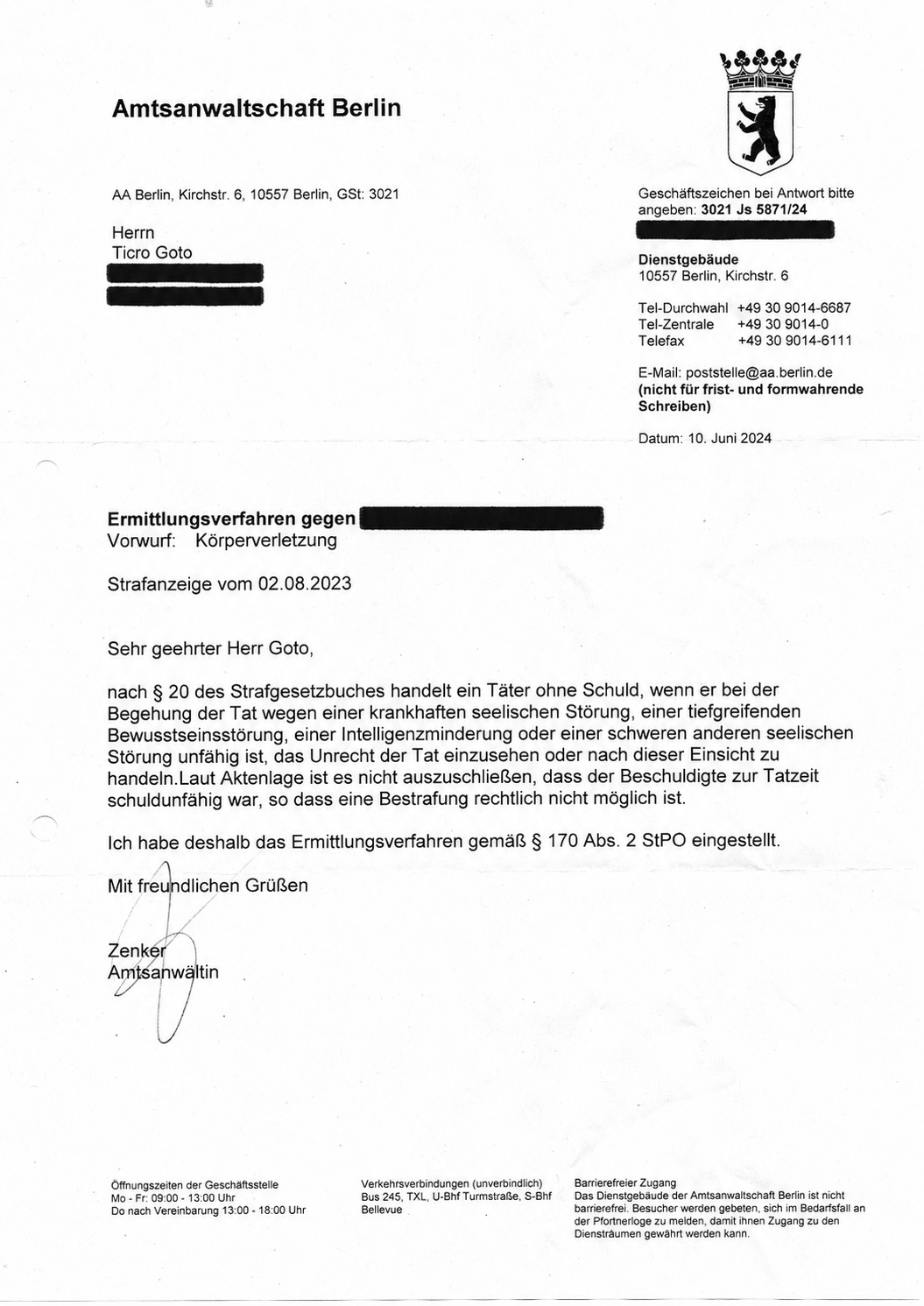
That someone who smashes a stranger’s skull is mentally ill is a tautology. I know the criteria for commitment. The man met them. He was not committed.
Today, the perpetrator walks free. Whoever is healthy enough to smash my skull in, is sick enough not to be punished for it.
III.
In front of the REWE City on Wundtstraße, another man attacked me. He was holding a vodka bottle, ran toward me, and shoved me. Then he punched and kicked at me, shouting something. I backed away and ran into the store, because someone inside had to react.
What happens in front of a supermarket in Berlin interests no one. Whoever kills someone inside is violating house rules.
The calculation worked. The staff called the police. The attacker fled, the officers searched the neighborhood and found him half an hour later. I waited in the store until an officer returned and showed me a photo on his phone. It showed the attacker in a park, holding a vodka bottle.
He looked relaxed. I asked what I should do if I run into the man again. The officer said he probably wouldn’t even recognize me. The intoxication that made him dangerous, made him harmless.
The police let him go. We probably live next door to each other now, mediated by the authorities.
IV.
Starting in the spring of 2025, a DHL delivery driver began dumping packages meant for neighbors in the upper floors at my place on the ground floor. The recipients were at home. They would come downstairs minutes later to pick up their package, indignantly confirming that no one had rung their bell. They apologized and advised me to refuse deliveries from this driver. So I did.
From that day on, he stopped delivering my own packages. He rang my doorbell roughly twenty times anyway, dragged his cart demonstratively slowly through the hallway, addressed me informally, asked how I was doing, and tried to force neighbor’s packages on me again. My own shipments remained in his truck, temperature-sensitive goods spoiled. Several times I ran after the van while it was still in sight. I filed complaints. DHL suggested I use a parcel locker, the Consumer Advice Center suggested the Trade Supervisory Office. The Federal Network Agency did not reply.
The only message that was successfully delivered was that no one is responsible.
In April 2026, he stood at my door again. He held my package tightly, told me I had to accept packages for the neighbors. I said no. Slowly, he let go of my package. I signed for it, closed the door.
Then he rang the bell incessantly. I opened the door, he stood an inch from my face and barked at me. He claimed my signature was fake. Then he ripped the package out of my arms and walked away. I ran after him, my body shaking. He demanded to see my ID. I said my signature is my signature, carefully pulled the package from his hands, and went back. He yelled through the hallway that he would never deliver a package to me again.
Two weeks later, I filed criminal charges for coercion and attempted theft. The police recorded it. Two months later, I asked for an update. No one replied.
He continues to drive through my street, carrying packages for others. He sees me too, and what he sees, he hasn’t forgotten.
V.
When I was looking for a new roommate and posted an ad online, a woman applied. She lived with me for a two-day trial, waited until I went grocery shopping, and then ransacked my apartment. When I came back, she was gone, along with everything that was of value to her and fit into two backpacks.
The Public Prosecutor’s Office dropped the case. They relied on an existing, older psychiatric evaluation. No new evaluation for this crime, no preventive detention proceedings, no review of psychiatric measures.
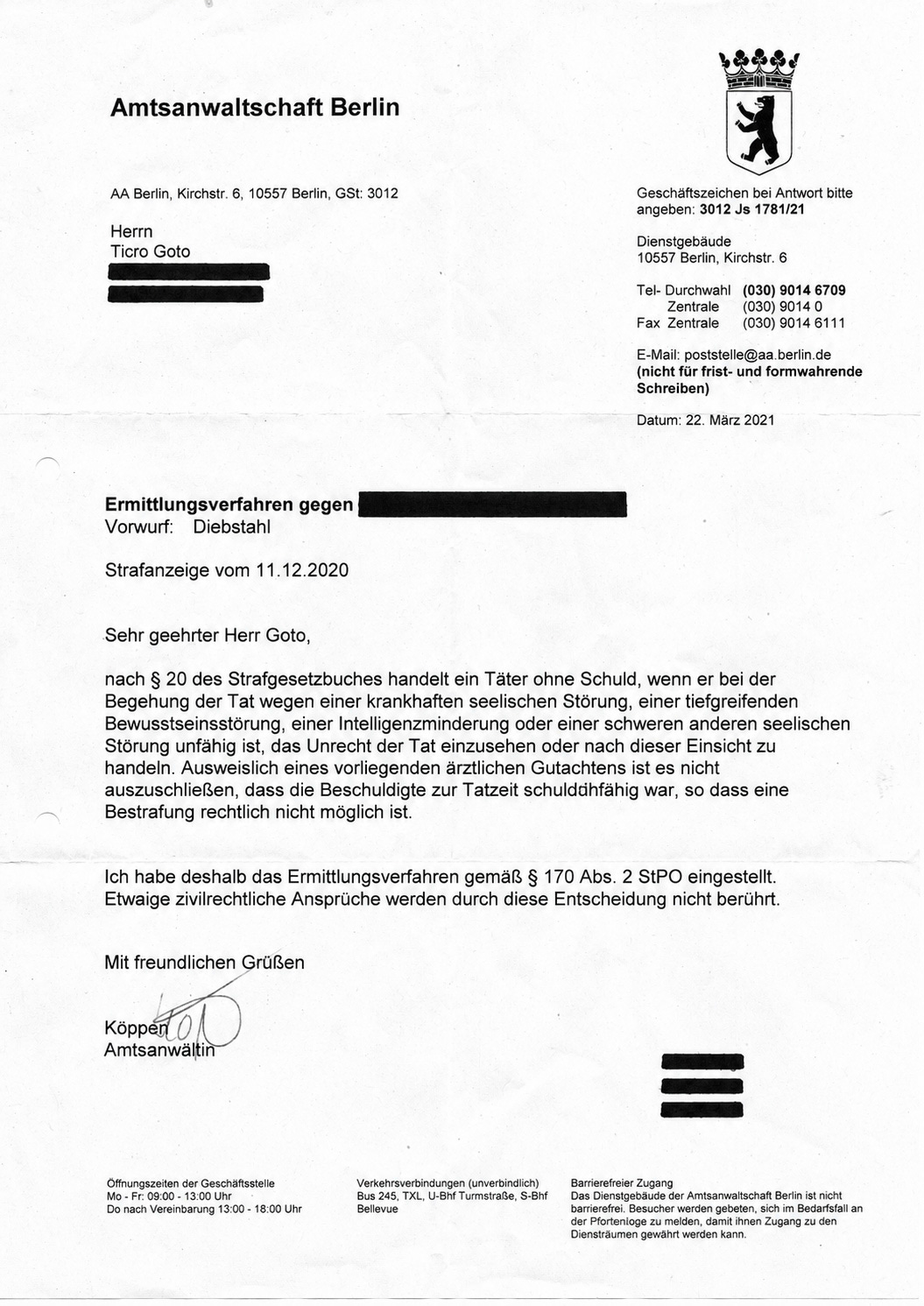
Mentally ill enough to steal. Mentally ill enough to locate the address. Mentally ill enough to sign the lease. Healthy enough to commit fraud, too sick to be held liable. The diagnosis swallows every crime.
VI.
A couple moved into my shared apartment as subletters. After a week, they were like different people. The smell of cannabis hung in the apartment. The man had fits of rage, bullied me, spat, burped, and stomped in front of my room to keep me from working. I wore earplugs and construction earmuffs and still heard him. He invented accusations just to insult me. When I told him that smoking weed in the apartment was prohibited by the sublease, he started hitting me and damaging furniture. He weighed multiples of what I do.
A friendly neighbor from across the hall heard the commotion and called the police. The officers arrived and spoke to me first, in the courtyard. The man had kept me from sleeping for weeks. I was trembling, could barely get a word out. Afterward, they spoke to the couple in the hallway of the apartment.
From my room, I heard the police ask the man what living with me was like. He sighed, described me as violent. His girlfriend confirmed it. They had plans for the apartment, he said. The officers nodded. Then they discreetly asked if I was taking any drugs. The man who was beating me was smoking weed in my apartment.
Then they left, the guarantors of fundamental rights. The door closed, the violence did not. The couple stopped paying rent. I issued a warning, then evicted them without notice. They hired a lawyer who invented reasons why they should be allowed to stay. After receiving a phone call threatening physical harm, I had the locks changed. To protect my life, which the police considered so cheap.
They were never charged, never treated, never committed. After all, they had only attacked me.
VII.
After a grocery run, I set my bags down at home. Then my right arm popped out of its socket. It hung by my body as if held by a single thread. I crawled to my phone, called for an ambulance. Then I crawled to the front door to unlock it. The paramedics arrived and saw the shoulder. They carried me into the ambulance. I was screaming. But they didn’t start driving. Instead, one of them started filling out a protocol. The arm was hanging loose. His pen scratched calmly across the paper.
He asked questions. I said I would answer everything as soon as the arm is back in. He said: questions first, or we don’t drive. Cold sweat broke out, everything turned white. I couldn’t think, tried to answer the questions.
He smirked.
In the ER, they put me on a stretcher and disappeared. I was still screaming. No one came. After half an hour, I lost feeling in my arm. First the fingertips, then the hand.
I was lying on a stretcher in a German emergency room watching my life end. I thought about everything I had worked for over the years. It didn’t matter anymore. In an hour, nothing would matter anymore.
Then the arm slipped back into the shoulder on its own. Spontaneous reduction. I felt my fingers again, my thumb, slowly. Everything ached. I lay there for another ten minutes, trying to comprehend. Then I stood up, walked to the observation room, wanted to speak. They cut me off, almost yelling. I should wait. I should go back to the room. Not a single glance at the arm. So I left. That was the emergency exit. No one stopped me. No one asked where I was going.
For a month I couldn’t sleep because of the pain, tossing and turning at night, waiting for morning.
The hospital is in Berlin. The file exists. No one was charged. The doctors keep practicing. The paramedics keep driving. The stretcher on which I screamed for an hour has been freshly made every day since.
VIII.
A few months prior, in the exact same supermarket where a man had beaten me bloody, I was suspected of stealing a wallet. The video footage showed a different man as the thief. Regardless, one of the two police officers who had been called slammed me against the building wall. He searched my entire body, supposedly for weapons. Then he put me in handcuffs. They drove me across Berlin to a precinct, stripped me naked, took my fingerprints, photographed me from all angles. I sat for an hour in a bright room with no door. Officers chatted across from me, laughing. I was not allowed to make a phone call.
Eventually, they pushed me out without a word. No apology, no explanation of where I was. I stood in a strange district in the middle of the night, asking strangers in a kebab shop to call me a taxi. For days afterward, I could still feel the hands of the police officers.
The executive branch continues to serve. The only difference between the thug on the street and the officer in front of the supermarket is the form that no one reads afterward.
IX.
Seven of these eight incidents are on record. The driver on Sophie-Charlotten-Straße was never found. No one faced criminal consequences.
I am writing to you because of the principle that legitimizes the violence and resolves every encounter at my expense. The apparatus acquits the thug, believes the abusive subtenant, fills out the protocol while the shoulder socket is empty, and where no perpetrator is at hand, it becomes one itself. The psychiatric diagnosis is the cleanest of these resolutions. It closes the file and the conscience.
Whoever attacks a stranger without cause is certified by Berlin practice as lacking criminal responsibility under Section 20 of the Criminal Code (StGB). The law prescribes preventive psychiatric confinement for this. Berlin prescribes dropping the charges. In criminal law, a lack of criminal responsibility is the reason to lock a perpetrator up until they are no longer a danger. In Berlin, it is the reason to let them walk.
Section 20 StGB precludes guilt, not the crime. Section 63 StGB mandates forensic psychiatric custody if significant unlawful acts are to be expected. Section 413 of the Code of Criminal Procedure (StPO) regulates the process to get there. In Berlin, cases are instead dropped under Section 170 II StPO, as the attached appendices 1 and 2 prove. In none of my cases was preventive confinement even considered. An authority that never considers Section 63 has effectively abolished it. Whether by directive or by habit changes nothing for the person who was beaten. The perpetrators see their victims again.
The condition that enabled the crime becomes the reason for impunity.
Anyone who reported everything wouldn’t be able to work anymore. The only punishable behavior in this system is the request for prosecution.
Article 2, Paragraph 2 of the Basic Law promises the right to life and physical integrity. The promise was never retracted. It is just no longer fulfilled.
The state’s monopoly on violence is bound to its protective function. Whoever claims the former and denies the latter operates its exact opposite while maintaining the letterhead. Criminal prosecution is a state matter. The violated law is federal law. Section 20, Section 63, Section 413 are federal law. Berlin does not read them. A federal state drops its rule of law. The federal government does not notice. Federalism reform serves as the alibi.
This is my first letter regarding this matter. I will continue to document. Anyone who has similar things to record knows where to find me.
I have written because you do not listen when one speaks. I expect Section 63 StGB to be applied when its prerequisites are met. I expect a criminal complaint to be processed once it is recorded. I expect Article 2, Paragraph 2 of the Basic Law to apply as long as it remains in the text.
I wanted this to be on record.
Whoever reads this and feels relieved that it happened to me and not to them, has not understood the letter.
Ticro Goto
(Still here.)